Media / News
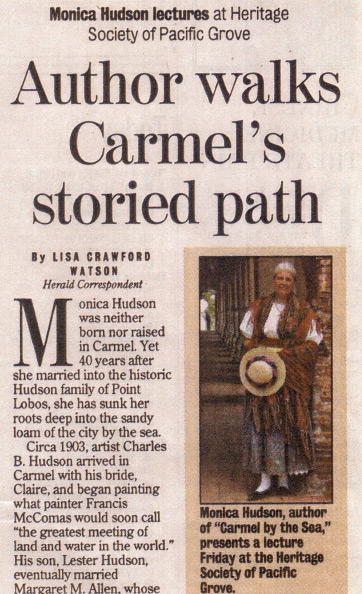
Monica Hudson lectures at Heritage Society of Pacific Grove
Author walks Carmel's storied path
Monica Hudson was neither born nor raised in Carmel, Yet 40 years after she married into the historic Hudson family of Point Lobos, she has sunk her roots deep into the sandy loam of the city by the sea.
Ca. 1903, artist Chares B. Hudson arrived in Carmel with his bride Claire, and began painting what painter Francis McComas would soon call "the greatest meeting of land and water in the world." His son, Lester Hudson, eventually married Margaret M. Allen, whose ranching family owned a large parcel of coastal ranchlands, including Point Lobos. The younger Hudsons reportedly were instrumental in preserving the land and encouraging the Allan family to deed point Lobos to the state.
A century later, the Hudson family remains across the street from the richly storied state park that harbors its heritage in its craggy coastline. Monica Hudson, trained and tenured as a teacher, saw the alchemy between her background and her husband's, thus forging a 20 year career as a guide for Point Lobos, weaving narratives out of the warp and weft of cultural and natural history.
Which likely is why Arcadia Publishing, renowned for its "Images of America" history book series, invited Hudson to write its Carmel-by-the-Sea installment. Published in 2006, the book forms the basis for her upcoming lecture, "Glimpses of Carmel-by-the-Sea." Presented by the Heritage Society of Pacific Grove, Friday's evening lecture will build narratives around nearly 100 historic photographs – a little less than half the collection included in her book.
"When they asked me to do a book on Carmel," said Hudson, "not knowing much about the history, I knew it was going to take a lot of research. I also knew the research and the writing should be based on photographs, so I went looking. Passed around like a bad penny I went from family to family – 60 of them all told – and had tea while I studied their photos. Some 1000 pictures later, I sat down to select 230 that would form the basis for my stories."
The good thing about trying to research the back story of Carmel-by-the-Sea is that the town thrives on its own history. Hudson was intrigued by how much people wanted to share their stories, and by what happened to each along the way.
"You couldn't make up anything crazier than what happened during the early days of Carmel-by-the-Sea. It was astounding," she said. "People came here from such diverse places and walks of life, and they all had their roles to play. There were artists who had little and artists who had plenty, and merchants who were building and running the town, and everyone together was creating this place. They fought hard to preserve what they had established, to maintain this village in the forest."
Hudson referenced Carmel poet Robinson Jeffers, who wrote on his first visit to town in 1914, "When the stagecoach topped the hill from Monterey and we looked down through pines and sea fog on Carmel Bay, it was evident that we had come without knowing it to our inevitable place."
The more Carmelites Hudson interviewed, the stakes, in her mind, grew higher and higher as people continued to entrust her with their stories. Her greatest satisfaction came when subjects read her book and said, "Yes; this is how it was'" as her words rang true to their own experiences and recollections. It was a lot of work, she admits, but worth every validation.
"I've known Monica for many years through our shared interest in local history," said Jeanne McCombs, Special Services coordinator for the Monterey Library, who, with Dennis Copeland, co-authored "Monterey Album; Life by the Bay," also published by Arcadia Publishing. "Monica is knowledgeable and professional, and her presentations are fact-filled and fun. I was so pleased she agreed to be part of the Heritage Society's Lecture Series. These lectures foster an appreciation for all aspects of local history, which deepens our understanding of who and what we are as a community today."
Although Hudson belongs to heritage societies in Big Sur, Pacific Grove and Carmel, and finds their histories inextricably linked, after 40 years, she considers Carmel her home, and is, like many Carmel residents, intent to "keep progress from endangering the residential character and Carmel's chosen way of life."
In fact, she concluded her book with the hope that people will build all their Carmel castles during the annual sand castle contest on Carmel Beach, and get such visions out of their system, so no one will want to actually develop the coastline and ruin the culture and canvas of the art community.
"It has been an awakening to see how when people move here," she said, "they want addresses and mail delivery, wondering, 'What is this business about the second house southwest of some street?' In the early days, people would go to the post office to visit their neighbors and find that pair of pink shoes they left on the beach, now tacked to the bulletin board."
Yet still to this day, despite the time and technology that has influenced the city by the sea, Hudson leaves readers with the hope, the promise and the charge that "the unique character, flavor and mystique of this little paradise, set in incomparable natural beauty, still exists, a treasure to behold, enjoy, nurture and preserve."